William Blake Now by Higgs John
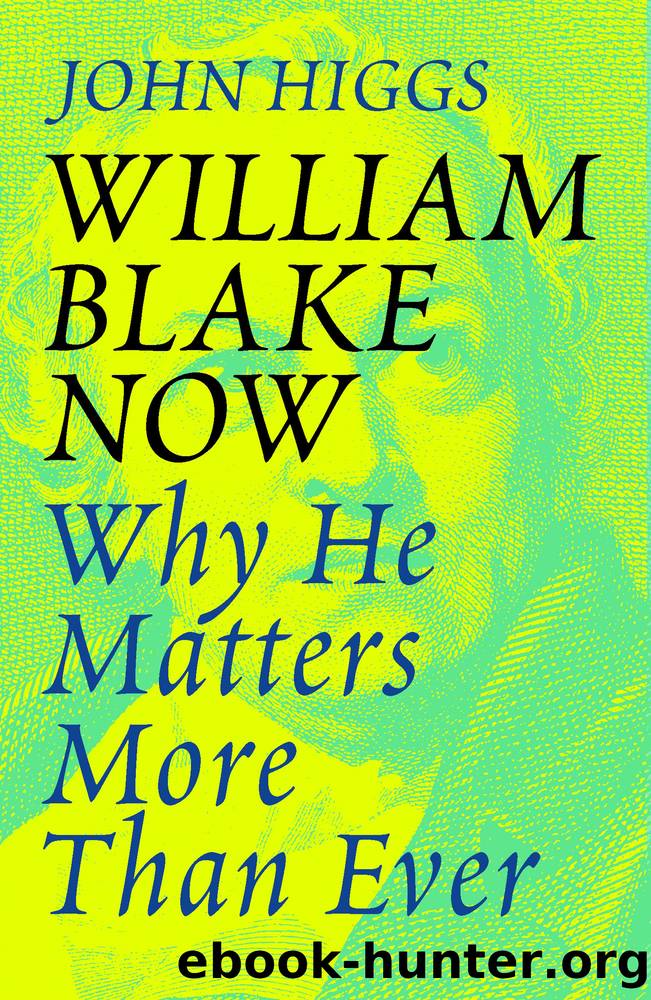
Author:Higgs, John
Language: eng
Format: epub
Publisher: Orion
7
Once Only Imaginâd
Blake was born in the Age of Enlightenment, which rejected the medieval idea that our most important value was faith. Instead, reason was declared to be primary. Only reason could trump faith.
For Blake, this wasnât going far enough. Reason was important, but it was only a small, bounded part of what the mind was capable of. Blake recognised that it was imagination, not reason, that was fundamental, because reason was only a product of the imagination. As he describes the situation, âWhat is now proved was once only imaginâd.â We use reason to understand the world, but it only shows us a tiny part of what is out there. When we become stuck, we have to go outside of established reasoning in order to find answers. Here Blakeâs position was similar to that of Albert Einstein, who said that âImagination is more important than knowledge. For knowledge is limited, whereas imagination embraces the entire world, stimulating progress, giving birth to evolution.â
Itâs worth stressing, however, that Blakeâs understanding of imagination is different to how the word is typically understood today. If you ask someone in the twenty-first century what the word âimaginationâ means, they will probably say that it is just making stuff up. This is not how the word used to be understood.
According to the Romantic poet Samuel Taylor Coleridge, there was an important difference between fantasy and imagination. Fantasy was indeed âjust making stuff upâ, he thought. It was essentially a form of mental collage â taking existing ideas and putting them together, in a way that was unrelated to the real world of time and space. You could take the idea of a horse and the idea of a horn, stick them together as a form of collage, and you had the fantasy of a unicorn in a world where no physical unicorns existed.
This was fine, as far as it goes. Fantasy could be entertaining in its own right. But it is unconnected to reality. It doesnât change things. It doesnât matter.
Imagination was something different. Imagination was the arrival, from the depths of consciousness, of something genuinely new. True, it might contain things that already exist, but they had now become part of something larger, and unprecedented. Coleridge invented the word âesemplasticâ to describe this process, in which separate elements are combined to create something entirely original. Fantasy was just the same old stuff rearranged with a healthy disregard for the real world. Imagination, in contrast, was engaging with existing stuff to produce something never seen before. This, being brand new, had the power to change the world in a way that fantasy did not. Something new now existed, and the world had to adapt around it.
Imagination had a vivid quality that fantasy lacked. In fantasy, a thought was just a thought. In deep imagination, a thought was something that you encountered. It was participatory. It was a living, vital process that you were part of. You were not separate from what you imagined, and imagination
Download
This site does not store any files on its server. We only index and link to content provided by other sites. Please contact the content providers to delete copyright contents if any and email us, we'll remove relevant links or contents immediately.
The Universe of Us by Lang Leav(15124)
The Sun and Her Flowers by Rupi Kaur(14566)
Adultolescence by Gabbie Hanna(8962)
Whiskey Words & a Shovel II by r.h. Sin(8050)
Love Her Wild by Atticus(7793)
Smoke & Mirrors by Michael Faudet(6234)
Wiseguy by Nicholas Pileggi(5841)
The Princess Saves Herself in This One by Amanda Lovelace(5003)
Love & Misadventure by Lang Leav(4883)
Memories by Lang Leav(4845)
Milk and Honey by Rupi Kaur(4774)
Bluets by Maggie Nelson(4604)
Too Much and Not the Mood by Durga Chew-Bose(4386)
Pillow Thoughts by Courtney Peppernell(4328)
Good morning to Goodnight by Eleni Kaur(4263)
The Poetry of Pablo Neruda by Pablo Neruda(4168)
Algedonic by r.h. Sin(4092)
HER II by Pierre Alex Jeanty(3639)
Stuff I've Been Feeling Lately by Alicia Cook(3490)
